Borderlands: Memory, Identity and Current Border Issues
Borderlands are more than just transitional areas between territories; they are sites of condensed history, conflictual memory and cultural negotiation. In this course, we consider border areas as socially constructed landscapes in which historical ruptures, political boundaries and collective memory are reflected. The course combines perspectives from geography, sociology, history, architectural history and cultural heritage research to examine the symbolic and material character of spaces. The focus is on the Alpine region, in particular South Tyrol and neighbouring areas, whose history has been shaped by border shifts, autonomy efforts, wars and EU integration. The course also focuses on the question of how border areas are remembered, represented or overlooked today – and what social and political challenges this poses. This interdisciplinary course is open to all interested parties and conveys general scientific content at the interface of history, political geography, sociology and cultural heritage research.
Borders and control regimes: rethinking space, power and differences
Anna Casaglia
The artificial and contingent nature of borders and frontiers is the central theme that will guide this talk. We will discuss mobility, physical, administrative and symbolic barriers, technologies and racial profiling, and how borders have become decisive in the production and reproduction of inequalities and asymmetries. The aim will be to critically analyse the recent radicalisation of mobility governance practices, with a focus on deportations and the criminalisation of migrants.
CV
Prof. ass. Anna Casaglia
Anna Casaglia is Associate Professor in Political and Economic Geography at the School of International Studies and the Department of Sociology and Social Research, University of Trento (Italy). She holds a PhD in Urban and Local European Studies from the University of Milano-Bicocca (2011), with a dissertation on the divided city of Nicosia. Her research focuses on critical border studies, political geography, migration and security, climate mobility, and the geopolitics of borders. She works at the intersection of feminist, decolonial, and critical approaches to bordering practices, with particular attention to the Mediterranean and European border regimes. She has been President of the Association for Borderland Studies (2023–2025) and serves on the Steering Committee of the International Geographical Union’s Commission on Political Geography. She is a member of the editorial collective of ACME: An International Journal for Critical Geography and of the editorial board of Geopolitics. Her recent publications appear in journals such as Political Geography, Geoforum, Environment & Planning C, Geopolitics, and Journal of Borderlands Studies. She is the author of Nicosia Beyond Partition. Complex Geographies of the Divided City (2020). She teaches courses on Political and Economic Geography, Geographies of Security, and Critical Geographies of the Anthropocene.
Foto by Alizée Dauchy
Foto by Alizée Dauchy
15. 04. 2026 20.00—22.00, DE, Tessmann Library
Across borders? From San Diego to Trieste! On the emergence, overcoming and exploration of borderlines, border areas and border landscapes
Michael Falser
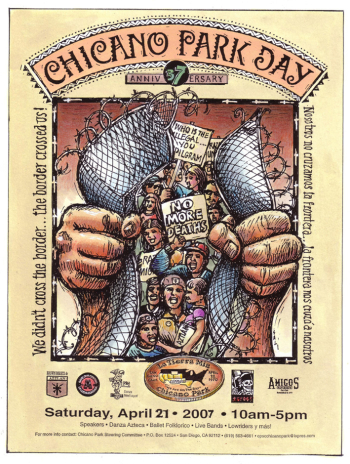
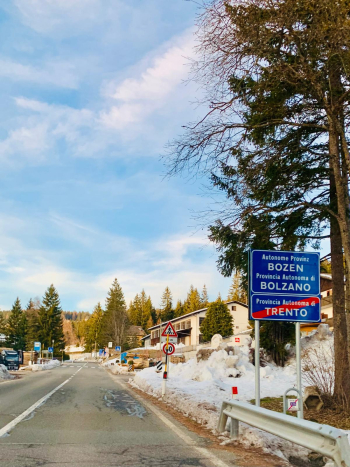
How do borders arise? What happens on both sides of borderlines? What cultural and artistic practices emerge in border areas, and what technical regimes stabilise large-scale border landscapes or help to connect them? And how can we understand these ambivalent formations from a historical perspective and evaluate them from a contemporary perspective? This lecture examines these questions from an interdisciplinary approach that incorporates aspects of art and architectural history, infrastructure research and cultural heritage studies. The journey first takes us to the curious Chicano Park in San Diego, Southern California, USA, where a Mexican-American working-class community counters exclusionary policies with monumental graffiti artworks. The second case study takes us back to historical Europe and highlights how the railway, as the (internal) colonial medium of the 19th century, helped Vienna as the centre to connect the cultural areas of the late Habsburg Monarchy to their borders – from Lviv to Bolzano and Trento, and from Reichenberg to Trieste and Sarajevo.
Conference in German.
CV
PD Dr.-Ing. Mag. Michael Falser
The architectural and art historian studied in Vienna and Paris and completed his doctorate at TU Berlin with a dissertation on the political history of monument preservation. After working as a conservation architect in the United States, he held research assistant positions at LMU Munich and ETH Zurich. As project leader for Global Art History and Cultural Heritage Studies within the Excellence Cluster “Asia and Europe in a Global Context” at Heidelberg University, he completed his habilitation in 2014. He has had visiting professorships in Kyoto, Heidelberg, Vienna, Bordeaux, Paris-Sorbonne, and Ottawa, and obtained a DFG Heisenberg Fellowship (2020–2024) at TU Munich, where he conducted a research project on German colonial architecture in Africa, Asia, and Oceania. He is currently Privatdozent at the Institute of European Art History at Heidelberg University and works as an independent expert and curator based in Vienna. His research focuses on global art and architectural history from the nineteenth to the twenty-first century, cultural heritage studies, monument preservation, and UNESCO World Heritage. Among his latest publications Monuments and Sites De-colonial! Approaches to the Built Heritage of the German Colonial Era. Berlin 2024; Habsburgs going global. The Austro-Hungarian Concession in Tientsin/Tianjin in China (1902-1917). Wien 2022 and Angkor Wat – A Transcultural History of Heritage. Berlin 2020.
16. 05. 2026 09.00—16.00, DE, Treffpunkt Gampenpass
Exkursion: Grenzlandschaften: Erinnerung, Identität und die „unsichtbare Grenze“ zwischen Tret und St. Felix
Prof. Ingrid Kofler
Im Rahmen des Studium Generale der unibz „Grenzlandschaften. Erinnerung, Identität und aktuelle Grenzfragen“ führt diese Exkursion an einen besonderen Ort: die sogenannte „unsichtbare Grenze“ zwischen Tret (Trentino) und St. Felix (Südtirol).
Diese Grenze ist nicht als physische Barriere sichtbar, sondern manifestiert sich historisch, sprachlich, kulturell und administrativ im Alltag der Bevölkerung. Sie verweist auf jene „hidden frontiers“, die John W. Cole und Eric R. Wolf in ihrer Studie zur Grenzregion beschrieben haben: unsichtbare soziale, kulturelle und ökonomische Trennlinien innerhalb eines vermeintlich homogenen alpinen Raumes. Auch neuere Ansätze verstehen Grenzen nicht nur als staatliche Linien, sondern als vielschichtige, historisch gewachsene Geflechte aus Macht, Identität und Alltagspraxis.
Die Exkursion verbindet historische, kulturwissenschaftliche und landschaftliche Perspektiven: Ausgangspunkt ist der Gampenbunker als materielles Zeugnis territorialer Sicherung während des Faschismus. Entlang des Pilgerwegs nach Unsere Liebe Frau im Walde werden Fragen von Erinnerung, religiöser Praxis und Raumaneignung thematisiert. Im Anschluss führt eine Wanderung entlang der „unsichtbaren Grenze“ zwischen St. Felix und Tret in jene Landschaft, in der Sprach- und Verwaltungsgrenzen bis heute soziale Ordnungen strukturieren.
Organisation:
Treffpunkt: Gampenpass um 9/9:10 (Bus 246 Abfahrt Meran 8:10 Uhr) (Anreise individuell mit Bus oder PKW)
12:00 Uhr Mittagessen im Restaurant Cervo – Historisches Gasthaus zum Hirschen
13:00 Uhr Wanderung von Unsere liebe Frau im Walde nach St. Felix und Tret (ca. 2 Stunden)
Rückfahrt mit Bus von Tret (Bus 246 um 15:43 Uhr)
Die Kosten für Transport, Eintritt, Führung und Mittagessen sind von den Teilnehmenden selbst zu tragen. Fixe Kosten 10€ pro Person für Eintritt und Führung.
Die Exkursion erfordert festes Schuhwerk; für die Bunkerführung wird warme Kleidung empfohlen.
Eine vorherige Anmeldung ist erforderlich. Bitte schreiben Sie diesbezüglich an die E-Mail-Adresse: ingrid.kofler2@unibz.it
06. 06. 2026 11.00—17.00, DE
Exkursion: Grenzlandschaft Reschen
Dr. Waltraud Kofler-Engl
Der Reschenpass ist mit dem Brennerpass einer der wichtigsten historischen Alpenübergänge. Er war Teil der römischen Straße Claudia Augusta und ist Wasserscheide zwischen Mittelmeer und Schwarzem Meer. Diese geographische Barriere wurde jedoch erst mit der Annexion Südtirols durch Italien im Jahr 1919 zur Staatsgrenze und nach der Machtergreifung des Faschismus zu einer politischen, ideologischen und militarisierten Grenzlandschaft.
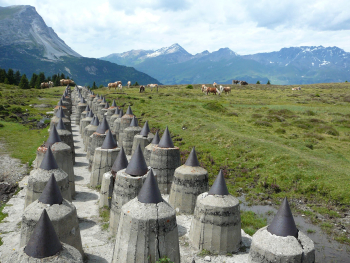
Davon zeugen bis heute zahlreiche bauliche Spuren in der Landschaft. Bauten wie das Ossarium (Mausoleum für die italienischen Gefallenen des Ersten Weltkrieges) an der Straße von Mals nach Graun sowie militärische Infrastrukturen als Teil des Vallo Alpino – darunter Kasernen, Militärstraßen, Panzerabwehrsperren und Bunker – nahmen die Grenzlandschaft des obersten Vinschgaus ideologisch und militärisch in Besitz. Einer der Bunker überbaute die Etschquelle und demonstrierte damit auch symbolisch die Eroberung und Kontrolle der Wasserscheide.
Neben der militärischen und ideologischen Inbesitznahme spielte auch die wirtschaftliche Nutzung eine entscheidende Rolle. Die bereits 1939 geplante staatliche Nutzung der vorhandenen Wasserressourcen zur Stromerzeugung, die 1950 für eines der leistungsstärksten Kavernenkraftwerke der Region zur Zwangsumsiedlung der Bewohnerinnen und Bewohner sowie zur Flutung der historischen Ortskerne von Altgraun und Reschen führte, zeigt die folgenschwere ökonomische Beanspruchung. Aus dem Stausee ragt bis heute der Kirchturm von Alt-Graun – ein weithin sichtbares Mahnmal für diesen tiefgreifenden Eingriff.
Mit der Aufhebung der Grenzkontrollen an den europäischen Binnengrenzen hat sich die Bedeutung der Region in den letzten Jahrzehnten erneut verändert. Die traditionellen Verkehrsverbindungen nach Nordtirol und in die Schweiz begünstigen heute einen intensiven wirtschaftlichen, touristischen und kulturellen Austausch über die Grenzen hinweg.
Die Exkursion im Rahmen des Studium Generale „Grenzlandschaften. Erinnerung, Identität und aktuelle Grenzfragen“ führt zu materiellen Zeugnissen in der Landschaft und thematisiert Fragen der sichtbaren und unsichtbaren symbolischen, militärischen und ökonomischen Inbesitznahme einer exemplarischen Grenzlandschaft.
Details zum Treffpunkt, zum Ablauf der Exkursion sowie zur Anreise mit öffentlichen Verkehrsmitteln werden noch bekannt gegeben.
Für die Exkursion sind feste Wanderschuhe und warme Kleidung erforderlich. Vorherige Anmeldung erforderlich: kulturerbe@unibz.it
Trieste and the north-eastern border: new mobility, identity and memory policies
Claudio Minca
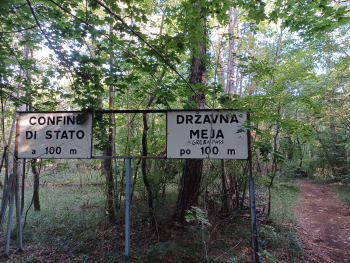
Trieste and the north-eastern border have long been a highly symbolic area for Italy's geopolitics. In recent years, Trieste has also become one of the main arrival points for migrants travelling along the so-called Balkan route. This has had consequences for the way in which the border with Slovenia has been managed and perceived. The arrival in Italy of thousands of informal migrants each year via the forest paths surrounding the city has justified the Italian government's temporary suspension of the Schengen agreements, highlighting the mechanism underlying the mobility differential applied to different individuals entering the country formally or informally. This lecture will analyse the political geographies that have marked these different forms of mobility, significantly redefining the role and image of this border.
Conference in Italian.
CV
Prof. Claudio Minca
Claudio Minca è professore ordinario di Geografia presso l'Università di Bologna. Prima di ricoprire questo ruolo, ha insegnato in diversi contesti internazionali, tra cui le università di Newcastle e Londra, nel Regno Unito, la Wageningen University nei Paesi Bassi e la Macquarie University in Australia. I suoi principali interessi di ricerca riguardano il rapporto tra teoria spaziale, biopolitica e modernità. Più di recente, si è dedicato all’analisi delle geografie politiche dei campi profughi. Tra le sue opere più recenti figuranoThinking like a Route (2026, con Y. Weima) eA Spatial Theory of the Camp (2025, con R. Carter-White). Ha recentemente vinto un ERC Advanced Grant per un progetto intitolato "The GAME: Counter-mapping informal refugee mobilities along the Balkan Route”.