Lecture in german
The ‘Mies’ Makers: Sophie and Alois Riehl and Ludwig Mies van der Rohe – An attic find is presented to the public for the first time
23 September 2026, 7.00 pm, unibz D1.01
Abstract:
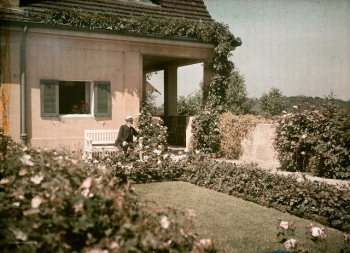
This lecture will present to the public for the first time an attic find that is exceptional in both scope and content. It comprises an extensive collection of around 1,000 letters and documents from the correspondence of Sophie and Alois Riehl (1844–1924), as well as letters from their family network. The speaker, Carsten Kriegenburg, offers new, personal insights into the life and circle of the Bolzano-born philosopher and university professor Alois Riehl and his wife Sophie (1855–1928). Alois Riehl was the brother of Josef Riehl (1842–1917), a railway pioneer, engineer and entrepreneur well known in this region. In addition to the written documents, around 60 previously unknown Autochrome photographs of the family from the years 1910–1913 will also be presented. These rare early colour photographs feature historically valuable images of South Tyrolean landscapes and places such as the Ritten, the Rosengarten, the Schlern, Bolzano, Seis and Kastelruth. Of particular significance in terms of architectural history are the early colour photographs of the Riehl House in Potsdam-Neubabelsberg (Klösterli), the debut work of the architect Ludwig Mies van der Rohe from 1908–1909. The lecture provides an initial overview of the available material and highlights its potential significance for the history of philosophy, culture and architecture.
CV
Carsten Kriegenburg is a civil engineer and expert witness who has been collecting historical film and photographic equipment, as well as related film and photographic documents, for decades. Research owes a sensational discovery to the trained eye of this passionate collector: a few years ago, he acquired the Riehl collection at an online auction – unseen, as a ‘pig in a poke’. Rather than breaking it up for profit or putting it into storage, he has, since the purchase, been working to catalogue the information through painstaking transcription and supplementing it with extensive research on the subject. Through a meticulous analysis of the find, he has been able, amongst other things, to demonstrate the decisive role played by the Riehl couple as early patrons and ‘driving forces’ behind Ludwig Mies van der Rohe’s international career.