Across borders? From San Diego to Trieste! On the emergence, overcoming and exploration of borderlines, border areas and border landscapes
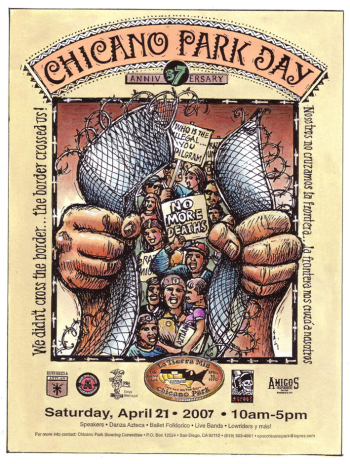
How do borders arise? What happens on both sides of borderlines? What cultural and artistic practices emerge in border areas, and what technical regimes stabilise large-scale border landscapes or help to connect them? And how can we understand these ambivalent formations from a historical perspective and evaluate them from a contemporary perspective? This lecture examines these questions from an interdisciplinary approach that incorporates aspects of art and architectural history, infrastructure research and cultural heritage studies. The journey first takes us to the curious Chicano Park in San Diego, Southern California, USA, where a Mexican-American working-class community counters exclusionary policies with monumental graffiti artworks. The second case study takes us back to historical Europe and highlights how the railway, as the (internal) colonial medium of the 19th century, helped Vienna as the centre to connect the cultural areas of the late Habsburg Monarchy to their borders – from Lviv to Bolzano and Trento, and from Reichenberg to Trieste and Sarajevo.
Conference in German.
CV
PD Dr.-Ing. Mag. Michael Falser
The architectural and art historian studied in Vienna and Paris and completed his doctorate at TU Berlin with a dissertation on the political history of monument preservation. After working as a conservation architect in the United States, he held research assistant positions at LMU Munich and ETH Zurich. As project leader for Global Art History and Cultural Heritage Studies within the Excellence Cluster “Asia and Europe in a Global Context” at Heidelberg University, he completed his habilitation in 2014. He has had visiting professorships in Kyoto, Heidelberg, Vienna, Bordeaux, Paris-Sorbonne, and Ottawa, and obtained a DFG Heisenberg Fellowship (2020–2024) at TU Munich, where he conducted a research project on German colonial architecture in Africa, Asia, and Oceania. He is currently Privatdozent at the Institute of European Art History at Heidelberg University and works as an independent expert and curator based in Vienna. His research focuses on global art and architectural history from the nineteenth to the twenty-first century, cultural heritage studies, monument preservation, and UNESCO World Heritage. Among his latest publications Monuments and Sites De-colonial! Approaches to the Built Heritage of the German Colonial Era. Berlin 2024; Habsburgs going global. The Austro-Hungarian Concession in Tientsin/Tianjin in China (1902-1917). Wien 2022 and Angkor Wat – A Transcultural History of Heritage. Berlin 2020.